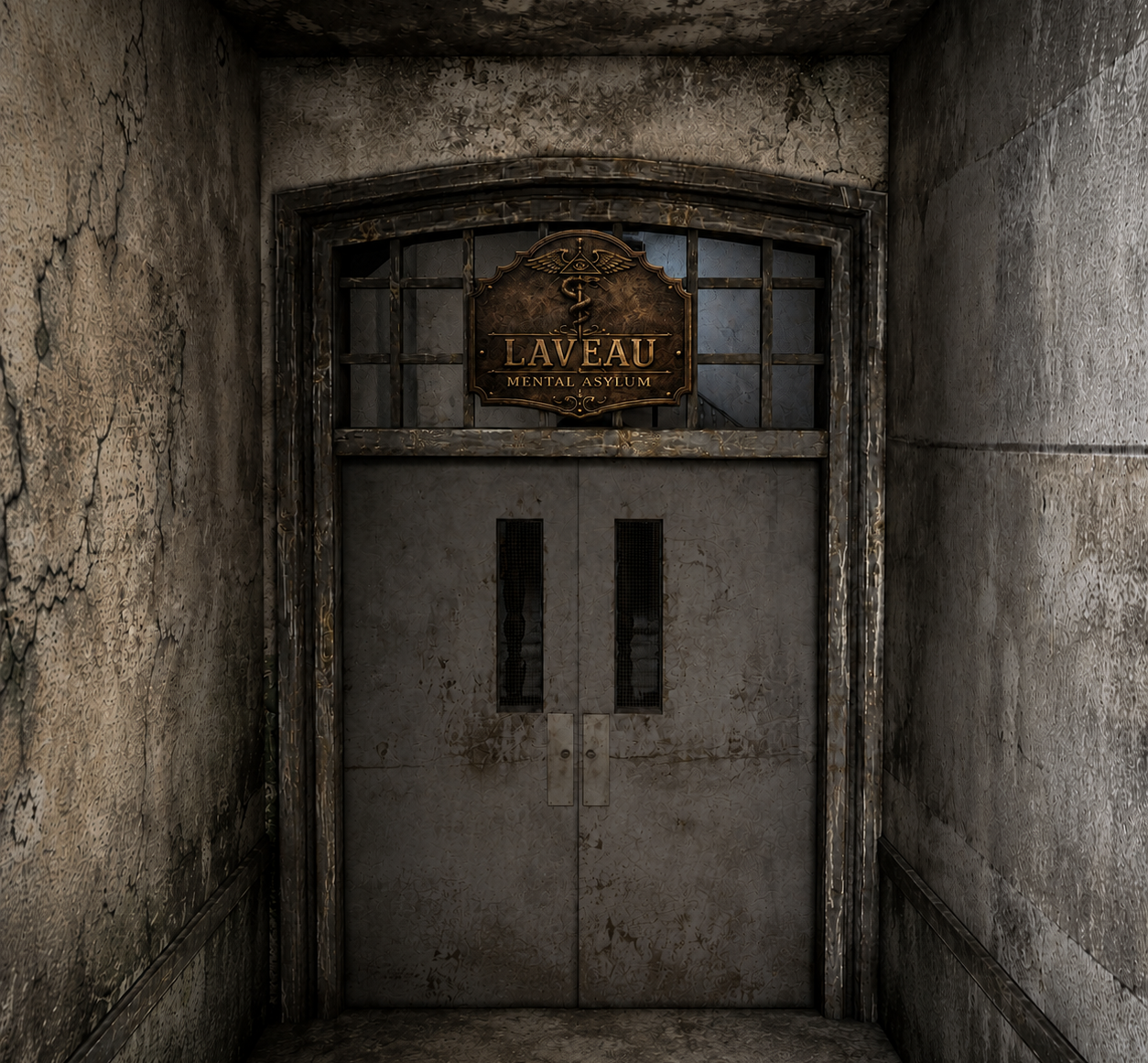
The Laveau Mental Asylum does not need a sign to announce itself. Its name arrives first, carried ahead of the visitor by old stories, civic unease, and the particular silence that gathers around institutions built to keep suffering out of sight.
Set within the same worn institutional shell that also houses the city’s medical clinic, the asylum does not greet visitors with warmth so much as procedure. A plain metal door, a waiting pause in the bayou heat, then the sudden opening into cooler air: clean, antiseptic, controlled. From there, the path inward is less a hallway than a sequence of thresholds. Staircases, keycards, doors, and more doors, each one closing behind the visitor with the quiet certainty of a place designed to keep careful track of what enters and what leaves.
The Warden Behind the Desk
We were received in the director’s office by Dr. Vasile Bellows, the asylum’s public liaison. Bellows is a man who appears to understand the weight of every word before he lets it leave his mouth. His accent carries a faint Eastern European trace; his manner is polished, almost diplomatic, though his eyes remain clinical and measuring behind his glasses. He does not waste gestures. Even his smile seems carefully placed, more instrument than habit.
Beside him sat Warden Kingston Varriale.
Bellows introduced him, with a tight smile, as “the heartbeat of this institution.” The Warden’s look suggested he might have preferred a less poetic description. For most of the interview, Varriale remained silent, his attention divided between the conversation and the files on his desk. It was a deliberate silence, not absence. Bellows spoke; Kingston watched. Between them, there was the unmistakable rhythm of an institution attempting to define its public face while keeping its true machinery discreetly behind it.
Not a Refuge, but a Shield
Asked what role the asylum should play in a place such as Laveau – a city too familiar with violence, addiction, trauma, and people made dangerous by survival — Dr. Bellows took a few seconds before answering. He did not describe the institution as a refuge.

“Laveau has quite the reputation, doesn’t it?” he said. “There is a danger anywhere that poverty and rot has taken hold. The lack of resources and good paying jobs breeds addiction and desperation. From there violence spirals, and in the thick of it is minds that are in need of reeducation. Reprogramming, if you will, for the good of the port we call home.”
The word might unsettle some readers, but Bellows framed it less as erasure than civic repair.
“The asylum has never prided itself on fixing what is broken” he continued “but instead on reassembling those jagged edges into functioning members of society. This is no refuge. This is the shield that protects Laveau from sick minds, and from itself. This is a place of discipline where addictions are traded for hope and where mental illnesses are not cured, but treated.”
Pressed on whether that means healing people as they are, or reshaping them into something the city can tolerate, Bellows turned the question toward the meaning of normality itself.
“Normal is a gradient here,” he said. “Those in our care will never be asked to be what they are not, and that includes normal. Instead we strive to make them the best version of themselves, a version that can walk out these doors as a benefit to Laveau.”
For many families, however, reassurance is not simply a matter of language. Laveau is a place where rumor often travels faster than fact, and where institutions are sometimes suspected of serving private interests before public good. Asked how the asylum convinces patients and relatives that commitment is care, not a convenient way to make someone disappear, Bellows acknowledged the burden of history.
He described rumor as almost a civic illness of its own – something produced by fear, boredom, and the city’s long appetite for stories.
“Distrust is hard to counter. Laveau runs on rumors,” he said. “The asylum has a brutal history, that is true, but that was the norm in the last century.”
According to Bellows, the institution operating today is not the asylum of old stories.
“The mental health institution that stands before you today has abandoned harsh treatment for effective therapies. We are board certified, and closely monitored, by the state board. It is impossible to go missing or to be lost in the system in the modern day, and rumors of such amount to nothing more than ghost stories.”
That is the message the asylum clearly wishes the public to hear: modern oversight, professional care, and no place for the abuses of the past.
At the same time, Bellows did not deny that the asylum must sometimes operate with firmness. The institution will receive vulnerable patients, dangerous patients, and, in some cases, people who may not arrive willingly. The distinction between treatment, discipline, restraint, and punishment is therefore not merely philosophical.
“We hire only the most well trained doctors and staff” Bellows said. “Our doctors are entrusted with the responsibility of each case they are asked to manage, and we allow them to do so as they see fit.”
He described a system in which patient behavior influences the structure of care.
Bellows did not pretend that every patient will respond to care with gratitude or cooperation. Nor did he pretend that the institution lacks methods of enforcement.

“Compliance is rewarded, and non-compliance is dealt with accordingly,” he said. “A violent patient who attacks staff will find themselves restrained. A patient who refuses to participate in their treatment will find their privileges stripped.”
To some ears, that may sound severe. Bellows anticipated that concern by framing discipline as part of treatment, not an expression of cruelty.
“These are the means we have available to ensure the best outcome for everyone involved,” he said, “but everything that is done is not for cruelty’s sake, but for the betterment of the patient.”
The asylum’s leadership is clearly aware that its language must walk a narrow path. Too soft, and the public will doubt its ability to handle real danger. Too hard, and families will wonder whether their loved ones are being treated as patients or problems. Bellows’ answer attempted to occupy the middle ground: firm care, professional discretion, and order in service of recovery.
An Ecosystem of Care
The asylum’s proximity to the medical clinic also raises practical questions. Laveau’s needs are rarely neat enough to fit into separate boxes marked body and mind. Earlier conversations with clinic leadership have already suggested a city where cooperation between institutions may become essential.
Bellows described that cooperation in ecological terms.
“Laveau is not an organism made of singular parts. It is an ecosystem,” he said. “Every institution, business, and agency functions as its own biome, each dependent on the health and activity of the others. When one thrives in isolation, the city stagnates. When they interact, the entire environment becomes self-sustaining.”
He confirmed that the asylum expects to work closely with the clinic.
“We will be working closely with the clinic to ensure the physical health and well being of our patients. Mental health cannot be fully addressed until physical ailments have been treated.”
Healing Without Erasure
On the question of safeguards, Bellows returned to the idea of agency — a word that appeared to matter greatly in the asylum’s public framing.
“Each patient comes to us as an individual with agency that has been stolen by a sick mind,” he said. “We seek to give them their agency back, not to strip more of it away.”
The asylum, he admitted, is by nature a private and guarded place. But he rejected the idea that secrecy means disappearance.
“We must always protect the privacy of those who come here for help,” Bellows said. “Nothing will be buried though, only placed in a well guarded file that can be accessed by anyone the patient wishes.”
It was only at the end of the interview that Warden Kingston Varriale chose to speak.
Until then, the Warden had allowed Bellows to carry the public burden of explanation. But when asked what should change in a patient who leaves the asylum, what should remain untouched, and what price would be too high to call that change healing, Kingston raised a hand, quietly indicating that Bellows’ input would not be needed.
“I hope they leave with choices they didn’t have when they arrived,” Kingston said. “Fear should no longer dictate their lives. Neither should addiction, obsession, delusion, grief… whatever chain brought them through our doors in the first place. A healthy mind isn’t one that never suffers. It’s one that’s capable of suffering without surrendering itself to maladaptive patterns.”
It was a striking answer, not least because it differed in tone from the more institutional language that preceded it. Kingston spoke less of discipline and more of personhood.
“There are things that should remain untouched,” he continued. “Curiosity. Individuality. The capacity to love. Even pain has its place. Remove every scar and you remove the lessons that came with it. The job of the asylum’s doctors isn’t to erase a person. It’s to help them become someone capable of carrying themselves.”
The Price of Healing
On the price of healing, Kingston was direct.
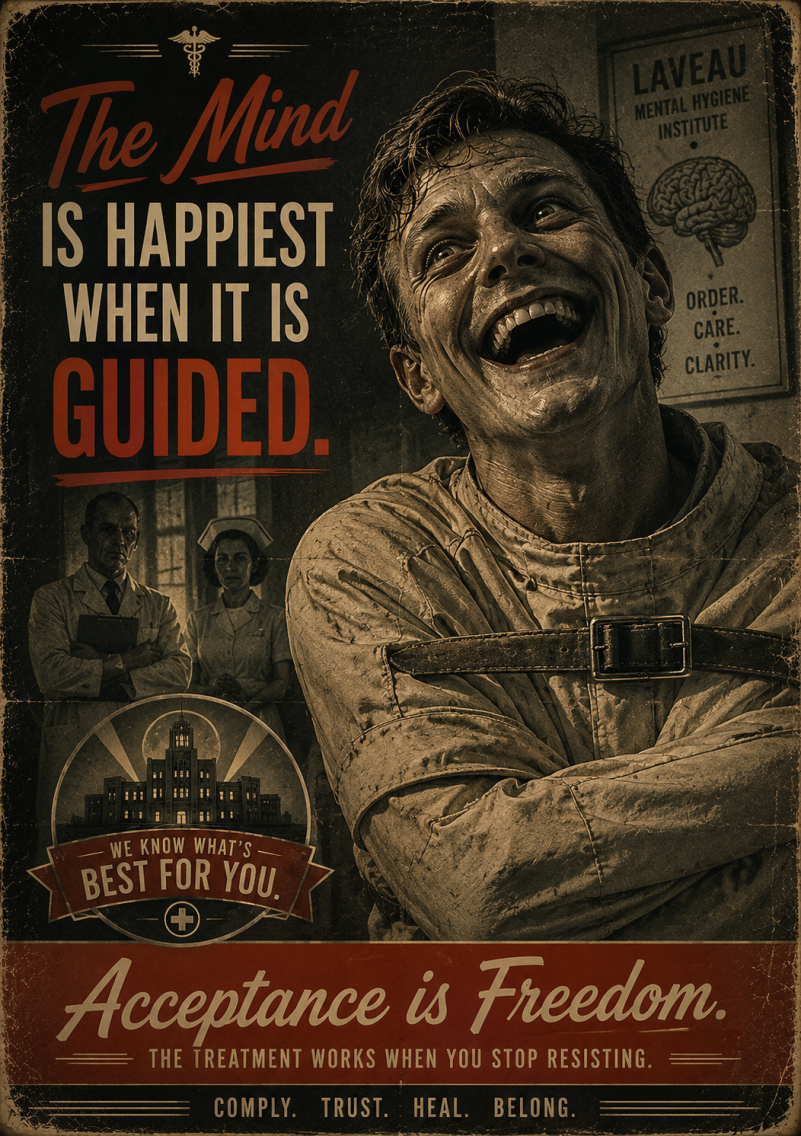
“If healing demands that a patient stop being recognizably themselves, then we’ve failed,” he said. “Compliance is easy to manufacture. Sedation is easy. Fear is easy. A broken person can look remarkably well behaved.”
He added that he would rather discharge someone “who still struggles but understands themselves” than someone who had forgotten who they were because it made the institution’s statistics look cleaner.
“The mind is not a machine with defective parts to replace,” Kingston said. “It’s an ecosystem. Disturb one corner carelessly, and you’ll find consequences growing somewhere you never intended. Real treatment requires restraint as much as intervention.”
For a city accustomed to hearing the asylum discussed in whispers, the distinction may matter. The institution’s doors are still heavy. Its corridors remain controlled. Its work will likely remain difficult, private, and, at times, uncomfortable to those outside its walls. But if the message offered by its leadership is to be taken at face value, the Laveau Mental Asylum is seeking to present itself not as a place where troublesome people vanish, but as one where damaged lives may be stabilized, treated, and returned to the city with greater strength than before.
The Work Continues
Before the meeting concluded, Kingston thanked The Ledger for taking the time to visit and added that any future questions should be brought directly to the institution. He also clarified that Dr. Vasile Bellows’ current position as public liaison is temporary, and that the asylum will be seeking a permanent replacement for the role in due course.
For now, Bellows remains the polished voice at the threshold. Kingston remains the quiet authority behind the desk. And beyond the locked doors and antiseptic air, the asylum continues its work — watched by the city, shaped by its history, and newly willing to answer questions about what healing should mean.