LAVEAU – Since moving to Laveau, I keep hearing the name Barracuda’s.
People mention it as though no explanation is necessary: a familiar landmark on the docks, a meeting place, a refuge, a source of rumors, and occasionally the setting for the sort of business nobody discusses too loudly. I have never actually seen it for myself, which makes the recent change of ownership a good excuse to satisfy my curiosity.
At that hour of the morning, the heat already hangs over the docks like a punishment.
By the time I reach Barracuda’s, the humidity has stripped away most of my professional dignity and left me with one urgent journalistic priority: finding a cold beer.
The Place
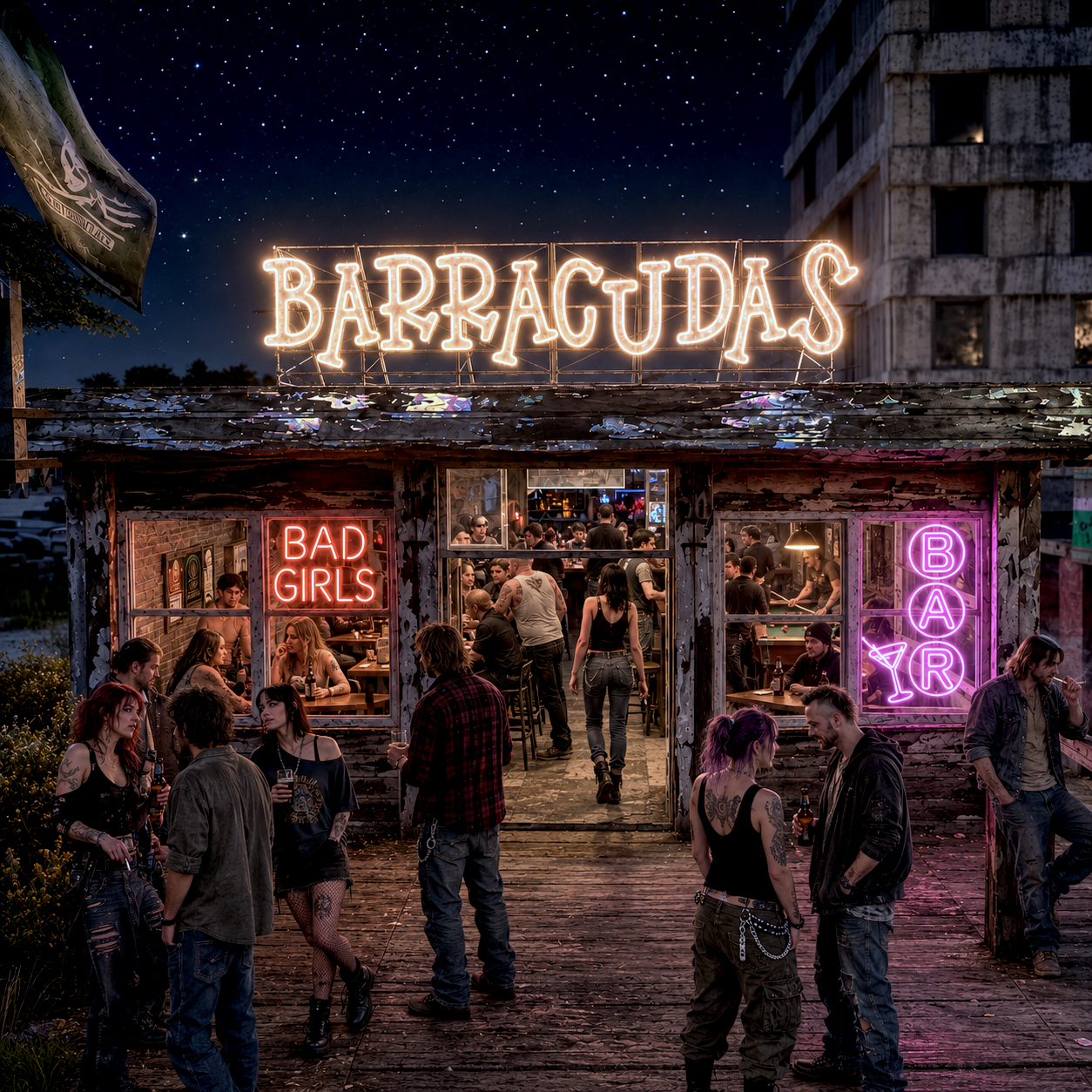
Barracuda’s sits low against the Port Laveau waterfront, all weathered timber, salt-stained glass and stubborn neon, the kind of place that looks as if it has survived an hurricane, several brawls and at least one very bad love affair. Its sign rises above the roof in battered letters, while pink bar-light spills onto the boards outside and catches on the windows like a warning.
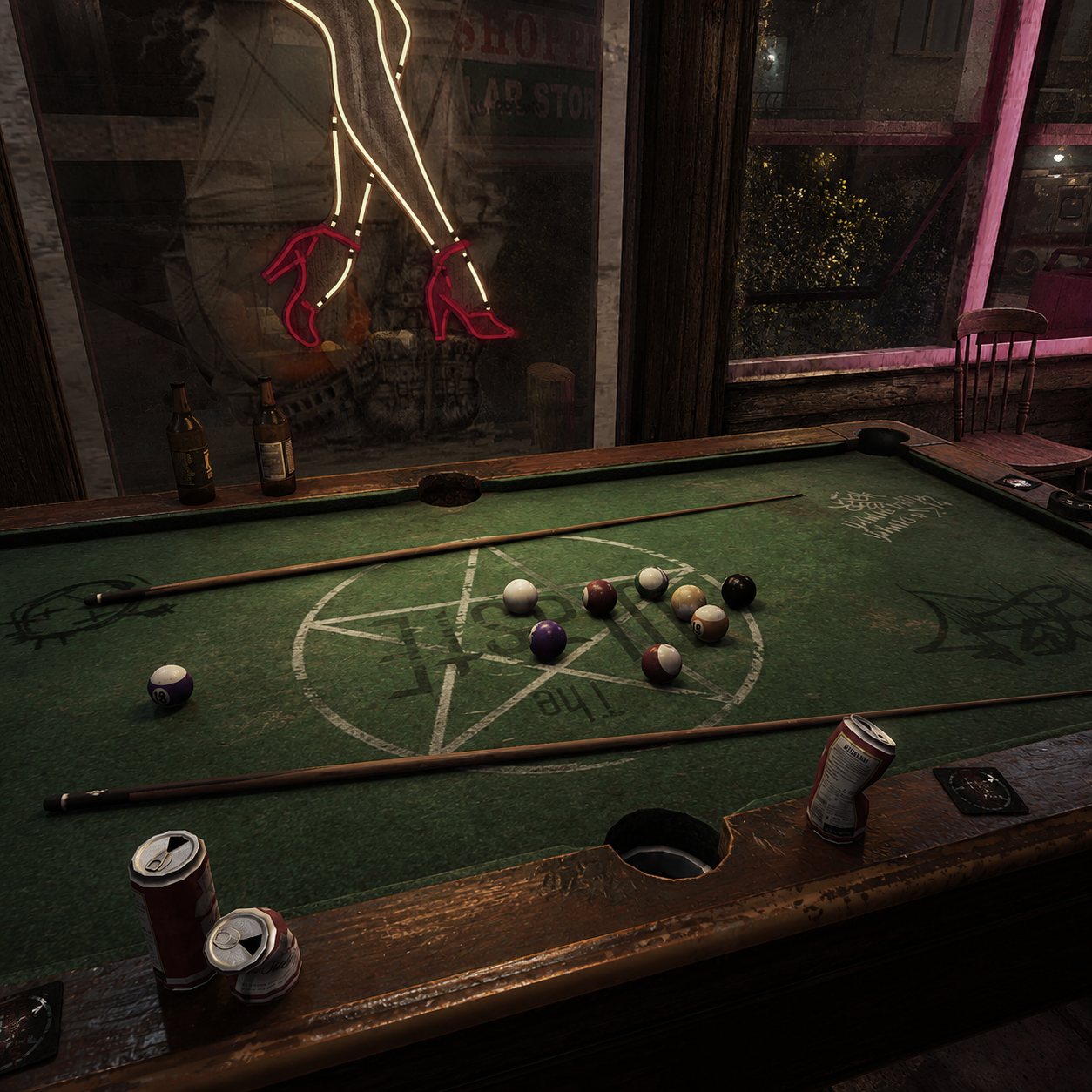
Inside, the place keeps its rough charm close. There is a pool table worn by years of careless hands, bottles lined behind the bar, hanging bulbs casting a lazy amber glow, and enough scuffed wood, graffiti and half-hidden posters to suggest that every regular has left a mark somewhere. The décor leans dockside dive more than polished lounge: loud, intimate, a little dangerous, but not without warmth.
Barracuda’s feels like a bar for bad decisions made honestly. A place for dock workers, drifters, girls with secrets, men with debts, and anyone who prefers their drinks poured strong under neon rather than served clean under chandeliers. By local standards, that may be as close to respectable as a bar needs to be.
Owners, Spirits and Policy
The first misunderstanding is cleared up before the beer is even poured. Barracuda’s is not reopening. It never truly closes. What is taking place is a change of ownership, handled carefully enough that the bar itself is barely disturbed by it.
“We’re planning a little gathering to do an official change of ownership,” Willow explains. “Give the locals a chance to wish Eira well, and to meet me if they haven’t already.”
That distinction matters to her. Willow does not speak like someone arriving to claim unfamiliar territory. She speaks like someone returning to a place that has been waiting for her.
Barracuda’s is her first job after she comes down from Hathian. She works behind its counter, leaves Laveau for a time, and then, in her own words, makes “a beeline” for the bar when she returns. Becoming financially responsible for the place may be new, but being behind its counter is not.
“Honestly, it doesn’t really feel different,” she says. “That’s one of the things I always loved about Barracuda’s. When you’re behind the bar, it’s sort of your bar, you know?”
For Willow, that sense of ownership should not belong exclusively to the person whose name appears on the paperwork. She wants the staff to feel trusted enough to take possession of the room while they are working—to welcome customers with the confidence of people who belong there rather than employees waiting for instructions.
It fits her management style. She is not planning to disappear into an office or supervise every exchanged glass and whispered conversation. She is more likely to be on the floor, speaking with customers, helping behind the bar and stepping in only when the evening threatens to roll too far sideways.
That approach is practical, but her connection to Barracuda’s runs deeper than professional history.

Willow describes it through the language of Vodun and Haitian Vodou: an umbilical connection to the land, a spiritual pull that draws a person back toward a place where part of their energy remains.
“The earth there literally holds a piece of their energy,” she says, “and the spirits are actively whispering to their soul to come back home. That’s how I feel about Barracuda’s.”
She does not insist that every customer share that belief. People may be drawn to the place because of the docks, the fishing boats, the promise of liquor or the simple convenience of finding a light still burning near the water. But they come. They always do.
“Maybe it’s because it’s a bar,” Willow admits with a laugh. “Maybe it’s because local ships, or someone using a boat to fish or gator hunt, come to the docks and see it because it’s right here. I’m not really sure. But it happens frequently.”
Whatever the reason, Barracuda’s serves as one of those places where Laveau naturally gathers.
It is not clean, safe or respectable in the polished sense of those words. It is a dockside bar in a town where respectable appearances are often the least trustworthy part of a building. Its worn pool table, crowded counter and view toward the water are not flaws awaiting correction. They are part of the place’s memory.
Willow has no intention of stripping that away.
“There will be no tearing down of anything,” she says, with the kind of certainty usually reserved for sacred vows. “The very frame of the place is sacred to me. Every new owner leaves a bit of their energy here.”
Trying to reinvent Barracuda’s, she argues, would suggest that something essential about it needs replacing.
“Sure, the menu might change and the drinks might be a tad different. But Barras is always Barras. I think that is what people count on here.”
That does not mean the new management will be invisible.
Willow wants more reasons for people to remain after their first drink: game nights, live bands, Zydeco and Swamp Pop, along with celebrations tied to Laveau’s local identity and spiritual traditions. The events are not meant to rely on heavy scripts or polished spectacle. The aim is to create activity, then leave enough room for people to find their own trouble.
A gathering on the pier might include music, drinks and food from neighboring businesses. It might also include rumors of something suspicious arriving through the docks after dark. Whether anyone follows those rumors is entirely up to them.
That balance—between community event and potential criminal incident—is perhaps the most natural thing Barracuda’s can offer.
The docks are never merely scenic. They are where fishermen return, strangers arrive, cargo changes hands and questions are discouraged. Smugglers, information brokers and people conducting business best kept out of daylight do not need to be forced into Barracuda’s atmosphere. They already belong to it.
Support for Each Other
Still, Willow’s most ambitious idea is not about criminals, spirits or mysterious shipments.
It is cooperation.
“My biggest want would be to hold joint events with the other businesses in town,” she says. “Those are always a great way to foster support for each other. Local commerce should have a united front in a town this size, or else it’s a recipe for disaster.”
In a larger city, a bar can afford to behave like an island. In Laveau, isolation is rarely sustainable. Willow wants Barracuda’s to work with the rest of the town through shared celebrations, holiday events and stories that move people from one local business to another.
She also wants the bar to remain approachable to those who have only just arrived—or, like her, are trying to find their footing after returning.
Barracuda’s may have an old reputation, but Willow does not want its history to become a locked door. New employees should be involved immediately. New customers should be drawn into conversations rather than left standing alone at the edge of the room. The place should feel established without becoming exclusive.
By the end of our conversation, the beer has done its work and the heat has become a problem for my future self.
When I ask what I owe, Willow refuses payment.
“You expect me to charge you when you’re providing free advertising?” she says. “Unless you hate the place—then try to be kind. Either way, the beer’s on me.”
The Song Remains the Same
Barracuda’s is changing hands, but Willow Catseye is not approaching it as an empty space waiting to be branded with her name. She sees herself as the latest caretaker of something built by many people over many years—a place that already possesses its own character, history and perhaps even its own spiritual gravity.
The menu may shift. The music may become louder. There may be more gatherings on the pier, more local celebrations and more reasons to wonder what arrives at the docks after midnight.
But the promise at the center of Willow’s plans is remarkably simple:
Barras remains Barras.
And yes, the beer is cold.