
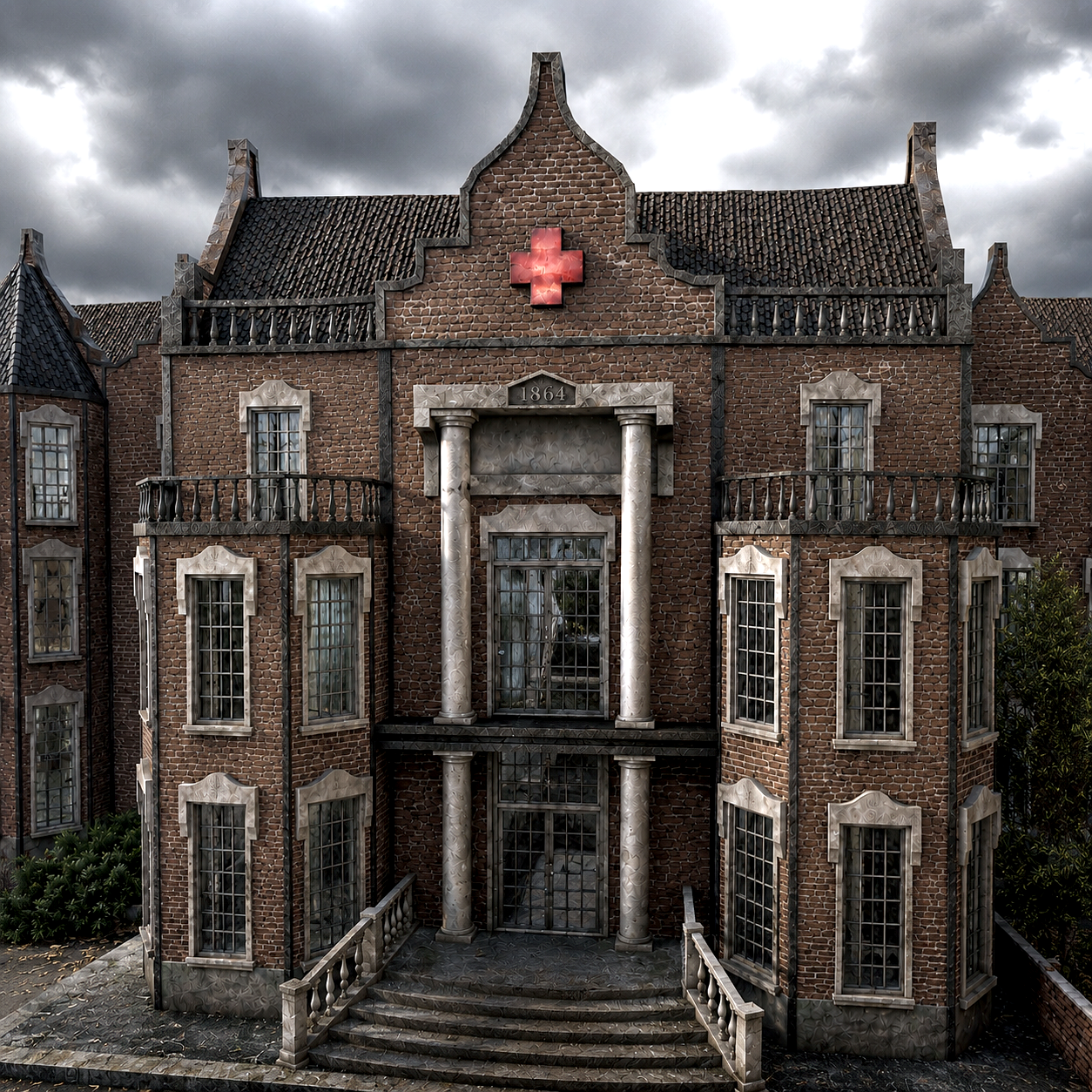
There are places in Laveau that do not need an introduction. They stand there like old scars, familiar even to those who have never stepped inside them. The clinic is one of those places.
Tucked beneath the same roof as the Asylum, the medical clinic has long been one of Laveau’s necessary institutions: useful, feared, rumored about, relied upon, avoided, whispered over, and returned to when there is blood on the floor and nowhere else close enough to matter.
It is into this complicated inheritance that Dr. Eira Sh’Zual has stepped in as the newly appointed Director of the clinic.
The meeting took place in her office, still not fully settled, still carrying that transitional feeling of a room becoming someone else’s territory. Dr. Sh’Zual herself did not present as a distant administrator hiding behind a title. She was warm, quick to laugh, visibly human, and visibly aware of the weight now placed on her shoulders.
There was tea. There were cakes. There was also, standing quietly nearby, Xaden Vedoran, whom Dr. Sh’Zual described with unmistakable affection as her right hand.
“He’s become something of my right hand honestly” she said. “I’m no sure what I’d do without him. He’s become like a son.”
It was a small moment, but a revealing one. Before speaking about buildings, disasters, rumors, emergencies, or ethics, Dr. Sh’Zual made clear that she thinks in terms of people first.
Asked who she is beyond the title and the white coat, the answer came without the polished coldness one might expect from someone newly placed in authority.

“For people tha’ don’a know me I’d prefer for tha title ta be one of tha last things they’d learn,” she said. “I’d rather they know who Eira is rather than tha doctor. Tha person tha’ just wants ta help people, regardless of what way that help is needed.”
She described herself as “someone tha’ enjoys a good laugh as much as she enjoys a good bourbon,” and, more importantly, as “a mother first, friend second and maybe even mentor next before doctor ever comes into play.”
That answer may tell Laveau more about the clinic’s future than any official announcement could.
Dr. Sh’Zual does not appear interested in pretending the clinic is something clean, detached, and imported from some better-behaved city. She does not speak of taming Laveau. She speaks of understanding it.
“The clinic has had many people try and tame it and I think tha’s been part of tha issue,” she said. “I understand the beast for what it is, it’s no meant ta be a carbon copy of any other hospital or clinic out there, it’s got its own personality, it’s own vibe and I intend ta embrace it rather than try and shape it into something I want.”
That may be the most Laveau answer possible.
For years, residents have questioned whether the local clinic can truly handle serious emergencies, or whether they should ask to be taken outside town when the situation becomes critical. Dr. Sh’Zual did not dismiss the concern.
“I’d say tha’ whether its an emergency or something like a chronic illness, we have the ability to see to all of Laveau’s needs,” she said, adding that she hopes to create “a working relationship with HGH” when specialized care is required, so that patients can still receive what they need “right here at home.”
She did not deny the clinic’s history. Instead, she placed it where she believes it belongs: in the past, not as a life sentence for the present.
“The clinic has had a history, much as most of the rest of Laveau has,” she said. “But the thing about history is tha’ its in tha past and though we need ta learn tha lesson of it, it doesn’a have ta hold true for what is in tha present either.”
Her request to the town is simple: give the clinic the chance to prove itself.
“I want this place ta be somewhere tha people don’a hesitate in coming too, in knowing tha’ they’ll have tha care that they need,” she said. “We can’a escape tha shadows of peoples fears until they give us a chance ta show them in person.”
Preparedness is also high on her list. Laveau knows storms, violence, injuries, illness, and the particular kind of public emergency that never arrives politely. Dr. Sh’Zual spoke directly about hurricane season and the need for readiness before the waters rise.
“The one good thing that we have going for us is tha’ we’ve had years ta examine what it is tha’s needed and what works best” she said.
She recalled treating a severe gator bite last year while at the Asylum, describing the conditions as close to a field hospital. That experience seems to have shaped her practical view of what the clinic must become: not pristine, perhaps, but capable.
“I want tha town ta know tha’ they’re in safe hands with tha staff here no matter the state of things outside those doors,” she said.
Her plans include first aid classes and disaster response scenarios, so that the clinic does not stand alone when crisis comes.
“Safety is our number one concern not just for us but for the residents Laveau too” she said, explaining that the goal is for everyone to be better prepared “when tha lights go out and tha waters rise.”
Of course, no conversation about Laveau’s clinic could ignore the rumors. Black market medicine. Missing organs. Experimental treatment. Favors owed. Stories that have passed from mouth to mouth long enough to grow claws.
Dr. Sh’Zual did not answer with outrage. She answered carefully.
“I think tha’ in tha end there is little I can do about rumors and hearsay,” she said. “I would be a fool ta just disregard them outright and I feel if I fought against them people would say I was fighting too hard and not trust me in tha regards anyway.”
It was perhaps the most honest answer of the interview. In Laveau, denial rarely kills a rumor. Sometimes it feeds it.
“There are dark aspects ta every town especially Laveau, every institution like tha asylum and tha clinic,” she continued. “And there have been those tha’ gave those rumors meat and teeth and there will always be those tha’ bring it up in a means ta hide and draw attention away from their own misdeeds.”
But she drew a firm line around her staff.
“What I can tell ya is I know my staff,” she said. “I know they have a genuine desire ta help people, ta bring back tha trust and faith of tha community and I stand by them and their talents.”
Trust, in Dr. Sh’Zual’s view, will not be rebuilt by speeches alone. It will be rebuilt by repeated contact, by consistency, and by Laveau residents seeing the clinic function when it matters.
“There’s no point in bein a clinic if tha town’s too afraid ta enter it,” she said. “But I also feel like if people are brave enough ta call this town home and settle down roots, they’re braver than just mere rumors.”
The clinic’s relationship with the Asylum may also become a defining part of its new direction. The two institutions share grounds, and Dr. Sh’Zual sees collaboration not only as practical, but necessary.
“Aye we are looking ta be in close collaboration” she said. “Would be a little hard not ta be with them being right upstairs.”
Rather than treating the proximity as a liability, she called both institutions cornerstones of Laveau.
“Tha clinic and tha asylum are staples of this town, cornerstones even, no different than Barra’s, Empire, tha Den or Veiled Visions,” she said. “Without them, this town loses a lot of its self reliance.”
That word, self-reliance, came up as more than a slogan. It is central to how Dr. Sh’Zual sees Laveau: not as a place waiting to be fixed by outsiders, but as a town that survives by knowing itself.
“We move at our own speed down here,” she said, “and the less we gotta travel north, tha better in my estimation.”
The final question was the sharpest one: in a town full of pressure, secrets, and competing interests, are there lines she will not cross as clinic director?
Dr. Sh’Zual did not hesitate.
“I think tha one thing tha people learn tha fastest is tha’ theres no one as loyal or as fierce as I am when it comes ta those in my care, she said.
Then came the answer that will likely stay with readers longest.
“If you’re asking me if I’d be willin ta cross ethical lines ta save a life or ta provide a person a better chance at livin a life of quality? Tha answer is yes. Proudly and loudly yes.”
It is not the kind of answer one expects from a sterile press release. It is not safe. It is not polished. It is also difficult to imagine a more fitting answer for Laveau.
“I’m no tha one ya call in when ya want someone ta pussy foot around and play by tha rules and wring their hands cause shit doesn’a get done” she said. “I’m tha one ya call in tha heart of a tempest and know tha’ I’ll stand between you and tha storm, regardless of what it costs me.”
And then, with the kind of certainty that leaves very little room for misunderstanding, she added:
“And honestly, I don’a think they’d want me any other way.”
Laveau has heard promises before. It has seen institutions rise, rot, change names, change hands, and keep the same old ghosts under fresh paint. Whether Dr. Eira Sh’Zual can turn the clinic into the place she describes remains to be seen.
But if her words are any measure, the new Director does not intend to make the clinic respectable by pretending it belongs somewhere else.
She intends to make it useful here.
In Laveau.
In the storm.